
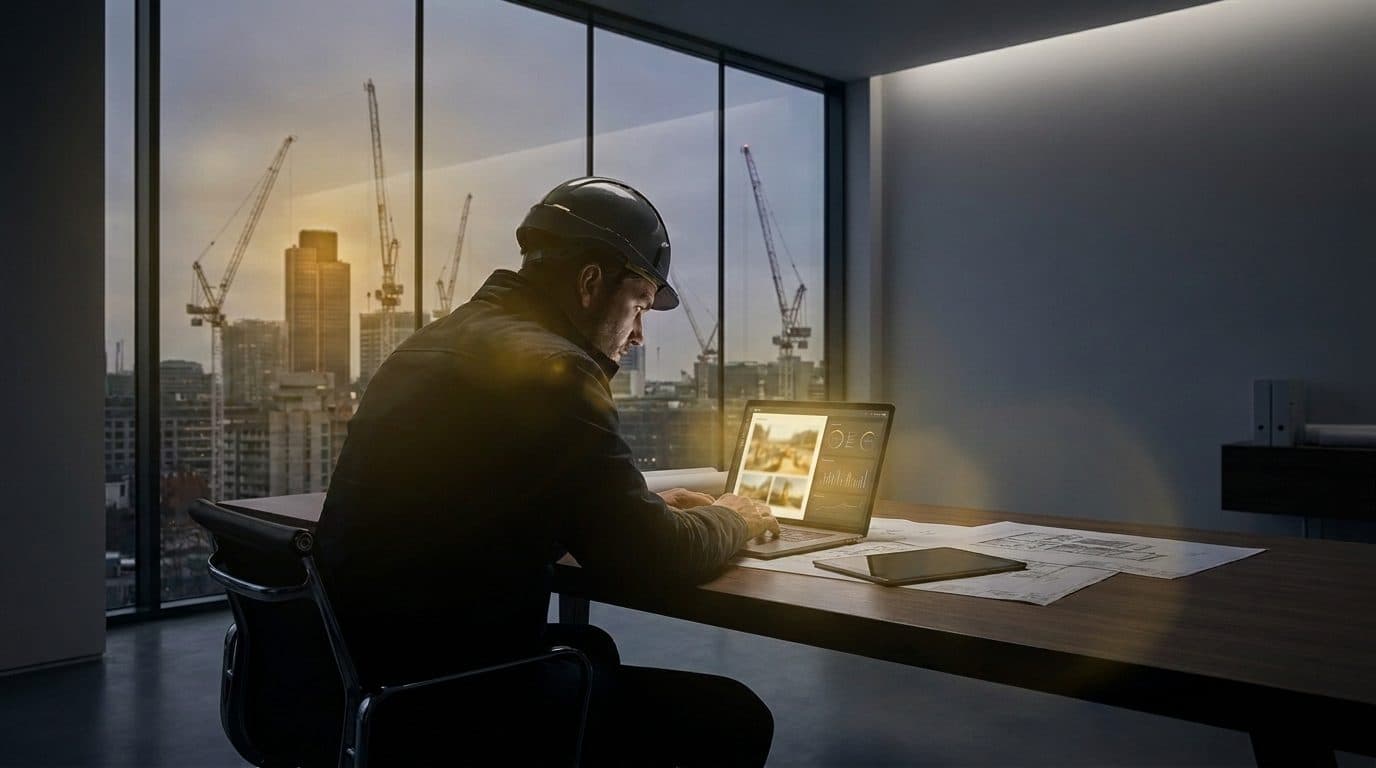
You started a construction business to be your own boss. Free from a commute, free from someone else setting your hours, free from a ceiling on what you earn. And here you are - still the first one on site, still the last one on the phone at night, still the person every problem gets routed to. The business got bigger. You did not get freer.
I built my way out of that pattern through what I now call construction arbitrage - the general contractor (main contractor in the UK) model run deliberately for margin. You win the work, price it, manage the trades, and keep the spread between the client price and the trade cost. You are never the worker on site. When you build it right, you are also never the person who has to be standing on site. Here is exactly how that works.
What running a construction business remotely actually means
Remote does not mean invisible. It means the business does not need your physical presence to function. You are reachable - by phone, email, video - but you are not driving between three sites before 9am or fielding calls from a scaffold. The jobs run because of the systems you built, not because of where your body is.
Here is what remote construction management actually looks like in practice:
- Leads arrive via digital ads, not from you driving to estimates.
- Every active job has a site lead - a trusted trade or foreman - who runs the ground-level operation.
- Client communication happens through a business channel on a scheduled rhythm, not via your personal mobile ringing at 7am.
- You can check the margin on every live job in under two minutes from anywhere.
- Two or three site visits per project, not daily attendance.
That is not a fantasy. That is a construction business run like a business - with documented processes instead of the owner as the single point of every decision.
How to win clients without driving to every estimate
Most contractors build their pipeline on word of mouth and local reputation. Both are real assets - but they put a ceiling on reach and fail in a slow market. Remote operators use paid digital advertising instead. The method: run Google Ads or Meta (Facebook/Instagram) ads targeting homeowners or developers who are actively searching for the type of work you do. They click, they land on a page built for one action, they request a quote.
You call them back, quote via phone or video, send a written proposal digitally, get it signed. The client has never met you in person. The job is won and it has not cost you a single drive across town. This is how remote operators build pipelines in areas they have never physically worked in before - and how they stop depending on whoever their last happy client happens to mention them to.
Inbound changes everything. When the client finds you, you are already the answer to the question they typed. You are not interrupting them.
@mointhemarket
Managing sites you are not standing on
This is where most contractors say 'but you have to be on site to know what is happening.' No. You need to know what is happening on site. That is a different thing from being physically there.
The remote site management structure that actually works:
- A trusted site lead on every job - a lead sub or foreman with clear written scope and defined authority to make ground-level decisions without calling you for every one.
- A daily or milestone photo routine - the site lead sends photos at set stages, not when they feel like it. You see the progress on your schedule.
- A group chat per project for trade coordination and updates you check once or twice a day - not reactively every hour.
- Clear escalation thresholds - the site lead handles X, escalates Y to you. No ambiguity. No 'should I bother him with this?' stalling.
- Two or three physical visits - scoping, a mid-point check on non-standard work, and the client handover. Everything else is managed remotely.
The trades do not need you watching them to do good work. They need a clear scope, the right materials on time, and a point of contact for genuine blockers. Build those three things and the site runs.
The tools remote operators actually use
No enterprise software required. Most remote construction operators run effectively on a small stack:
- Shared folder (Google Drive or similar) for scopes, quote templates, contracts, and photo archives. One place everyone can access, nothing lost in an email chain.
- Spreadsheet or simple job management app for per-job cost and margin tracking - a spreadsheet is fine to start, and a contractor CRM like PlanaJob when you outgrow it. You need to know revenue, trade costs, and margin per live job in real time - nothing more complex than that to start.
- A separate business phone number for client communication. Keep it off your personal mobile from day one on every new project.
- A group chat per site (a basic messaging app works) for photo updates and trade coordination. Simple, but it works.
- Video call for scoping and client updates. A walk-through on video with the site lead's phone is often enough to understand a site without a physical visit.
What you cannot skip even when working remotely
Remote does not mean exempt from compliance. As a general contractor managing trades on jobs, you still need proper licensing, insurance, and contracts in place - and what that looks like depends on where you operate. Licensing requirements for general contractors vary significantly by country and state. The insurance you carry as an operator managing other trades is different from what you held as a tradesperson, and it matters when something goes wrong. Get this right for your jurisdiction before you take on any jobs.
For a country-by-country breakdown of licensing, insurance, and compliance requirements across the USA, UK, Canada, Australia, and New Zealand, see the guide on whether construction arbitrage is legal - it covers exactly what the model requires in each market. The compliance layer is not complicated once you understand it, but it is specific to where you operate. A properly structured operator business is a legitimate, protected business.
What the money looks like
(Figures in USD - the model and the math are identical in any currency.) This is what the economics look like for a remote operator running three standard jobs in parallel:
| Job type | Client price | Trade costs | Operator margin |
|---|---|---|---|
| Bathroom gut-refit | $18,000 | $11,500 | $6,500 |
| Kitchen remodel | $28,000 | $18,000 | $10,000 |
| Room addition | $55,000 | $37,000 | $18,000 |
Stack three bathroom refits in a month and you are generating $19,500 in margin. Stack three kitchen remodels and you are at $30,000. These are not exceptional projects - they are standard jobs a competent general contractor wins in a functioning market. The difference between a contractor who earns $6,500 on one job and an operator who earns $6,500 on three simultaneous jobs is not talent. It is structure. And every dollar of those figures was earned from a laptop, from home, from anywhere - not from a scaffold.
This is the model that construction arbitrage is built on. The operator runs the margin. The trades deliver the work. The business earns whether or not you are on site. For a deeper look at how the operator model works end to end, explore constructionarbitrage.com.
The bottom line
Can you run a construction business remotely? Yes - and it is not a future trend. Operators have been doing it for years, using the general contractor model that was always designed to manage projects rather than build them. The shift is not technical. It is a decision to stop treating your physical presence as the product and start building the systems that let the business run without you being there. Digital leads, a trusted site lead, documented scopes, live financial tracking. Build those four things and the postcode you work from becomes irrelevant. Remote is not the reward for building the system. It is what happens when the system works.
If you are ready to build the operator model - jobs, margin, remote - request entry and see how the players are running it.
Request entry to Contractor Club⟶Frequently asked questions
Can you really run a construction business remotely?+
Yes. General contractors (main contractors in the UK) have always operated projects they are not personally building. Running remotely means building the systems - digital lead generation, trusted site leads, documented scopes, and live financial tracking - so the business does not require your physical presence to function day to day.
What do you need to run a construction business from home?+
Four things: a digital lead system that brings in inbound enquiries without in-person networking, a trusted site lead or lead subcontractor on every active job, a client communication process that does not depend on your personal mobile, and a financial tracker that shows every job's margin in real time. None of those require you to be on site.
Do you need to visit sites if you run a construction business remotely?+
Occasionally - typically for the scoping visit on complex jobs, a mid-point check on anything non-standard, and the client handover at completion. That is two or three visits per project, not daily attendance. Many operators work with site leads who handle even those stages entirely.
What software do remote construction operators use?+
Less than you think. A shared folder for scopes and documents, a spreadsheet or simple job management app for cost tracking, a business phone number separate from your personal mobile, and a group chat per site for trade coordination. The process matters more than the platform. Build the process first.
Is remote construction management legal?+
Operating as a general contractor from a remote location is legal - you are managing the project and the margin, not performing unlicensed trade work. The licensing and insurance requirements vary by country and state, so confirm what applies where you operate. For a country-by-country breakdown, see the guide on whether construction arbitrage is legal.
How do remote contractors win clients they never meet in person?+
Through inbound digital ads - primarily Google and Meta (Facebook/Instagram) - that drive enquiries to a landing page. The client fills out a form, you quote by phone or video call, the contract is signed digitally, and the job is managed via a site lead. Many remote operators never meet their clients face to face. The process builds confidence, not the physical presence.
The human behind The Playbook

mointhemarket Managing construction businesses across continents - with full location freedom. Running several at once. Bought and sold many more.
Go deeper
Learn the model, then get in the room
The full breakdown of construction arbitrage lives on our sister site, constructionarbitrage.com. When you want the operators who actually run it, join the Construction Arbitrage Players community.
My listening book THE EDGE is out now - 24 chapters on how the money really moves through a contracting business, made to be listened to on the drive. Free to start. See what is inside.
My book The Family Secret - how construction arbitrage really works - is coming soon.
Only Players Know
The game is real. The room is closed.
Contractor Club is a private, application-only circle of construction arbitrage operators. If you think you belong inside, apply and the circle will decide.
More from the Playbook
View all ⟶ Work Less & Systems
How to Get Off the Tools in Construction (Without Losing Income)
Your body is the only asset in a tools-first business, and it is depreciating. Here is the four-step path off the tools that does not start with hiring an employee you cannot afford.
 Work Less & Systems
How to Manage Multiple Construction Jobs at Once
Most contractors cap out at the number of jobs they can hold in their head. The operators who scale past that do not work harder - they run every job on one system.