

I get asked about passive income all the time. Every contractor wants money coming in while they are not on site. Most of the advice they find is useless - a $97 online course, a dropshipping side hustle, a rental van. None of that closes the gap on a construction income. But there is one model, specific to this industry, that genuinely pays you money on jobs you never set foot on. That is the one worth talking about. I will not pretend it is passive in the way a savings account is passive. But it is as close as construction gets.
What I am describing is called construction arbitrage - the model where you operate as the general contractor (main contractor in the UK), manage the margin, and never personally deliver the labor. It is the most profitable structure I have run in this industry, and the one that decouples income from site hours. Let me show you why the other options fall short first, then exactly how this one works.
Why most passive income ideas miss for contractors
A van or tool rental earns real but small income - a few hundred dollars per week in the best case (figures in USD - the model and the math are identical in any currency), and that assumes the asset is available, insured, and maintained. A digital course can generate strong income at scale, but takes a year of work before it pays anything meaningful back. Property rental requires capital first and is a multi-step strategy, not an entry point.
These are not bad ideas. They are supplementary income. None of them replace what you earn on site, and none of them scale to what the main business can produce. The income a contractor actually wants is construction-sized: tens of thousands of dollars a month, not a few hundred. And the only place that income comes from is construction jobs. The question is how you structure those jobs so your presence on site is not what makes them work.
The contractors who actually got free did not build a side hustle. They rebuilt the main business so it ran without them on site.
@mointhemarket
The model that actually works: general contractor for margin
Here is the core of it. A general contractor wins a job, agrees a price with the client, and then manages subcontractors to deliver the work. The operator keeps the spread between what the client pays and what the trades cost. This is general contracting run deliberately for margin. It is standard practice in the industry - every major construction company on the planet works this way.
Most contractors have always done both things at once: they win the job AND do the work themselves. When you separate those two roles - focus on winning, pricing, and managing, and let qualified subcontractors handle the delivery - your income no longer depends on your own two hands. You can run three jobs at once. You can be on a call with a new client when one of your active jobs completes. That is what construction arbitrage actually looks like in practice.
What the income looks like compared to other models
Illustrative numbers in USD - these are worked examples to show the shape, not stated as averages or survey data.
| Model | How it pays | Run multiples? | Rough per-unit income |
|---|---|---|---|
| On the tools yourself | Labor for hours worked | No - one job at a time | Day rate for days worked |
| Operator (general contractor) | Client price minus trade cost | Yes - 3 to 5 in parallel | $6,000-$15,000 per job |
| Equipment rental | Rental fee minus running costs | Yes - per unit owned | $200-$600/week per unit |
| Digital products or consulting | Sale or subscription | Yes - unlimited | Low to strong, slow to build |
The operator model is not a side income. It is the main business rebuilt. The other streams are real and they are worth building - but they sit on top of the operator model, they do not replace it.
What you actually do each day when the model is running
The word 'passive' creates the wrong picture. You are still working. What changes is the nature of the work. Instead of mixing, fitting, wiring, or tiling on site, you are pricing the next job, calling a sub to resolve a query, reviewing variations with a client, and checking the margin tracker. A well-run operator job takes an hour or two of active management per day once the system is rolling. Three or four jobs in parallel is a full working day - just not a physical one.
The contractors who make this shift describe the first few months as the hardest adjustment. Not because the work is harder, but because they have to stop picking up the tools when things get uncomfortable. The income model only works if you stay in the operator role. For more on how others are running it, the Construction Arbitrage Players community is where people run it together.
Other income streams worth adding once the operator model runs
- Maintenance contracts: The most direct recurring stream available to a trades business - converting one-off customers into a contracted monthly baseline that pays whether the phone rings or not. How to sell maintenance contracts covers who buys, the pitch, and the pricing that protects the margin.
- Equipment rental: Plant, tools, or specialist equipment sitting idle between your own jobs can generate rental income from other trades. Factor in maintenance costs, insurance, utilization rates, and the tracking admin before you count the margin. Real income, but not zero-effort.
- Teaching and consulting: Once you have a proven operator system - a real track record and real margins - other contractors will pay to learn it. Slow to build, but near-passive once the materials exist.
- Referral relationships: Some suppliers, materials merchants, and adjacent services offer trade partner arrangements. Verify the legal and tax position in your country and state before building these in - disclosure rules and tax treatment vary significantly.
- Property income: Some operators buy properties with construction profits and build a rental portfolio. This is a third or fourth step in the journey, not where you start.
How to start from where you are now
- 01Take the next job you are too busy for. Instead of turning it down, subcontract it. Price the whole job to the client, engage a trusted trade to deliver it, and keep the margin. That is the operator model on its first run.
- 02Build a short bench of vetted subcontractors - two or three per trade you regularly need. Vet them on smaller jobs first; never put a new face on a critical project without having seen their work.
- 03Price as the general contractor, not the tradesperson. Your quote covers the full outcome - all trade costs, materials, your overhead, and your operator margin. If you price it as if you are doing the work yourself, you have built in no operator income.
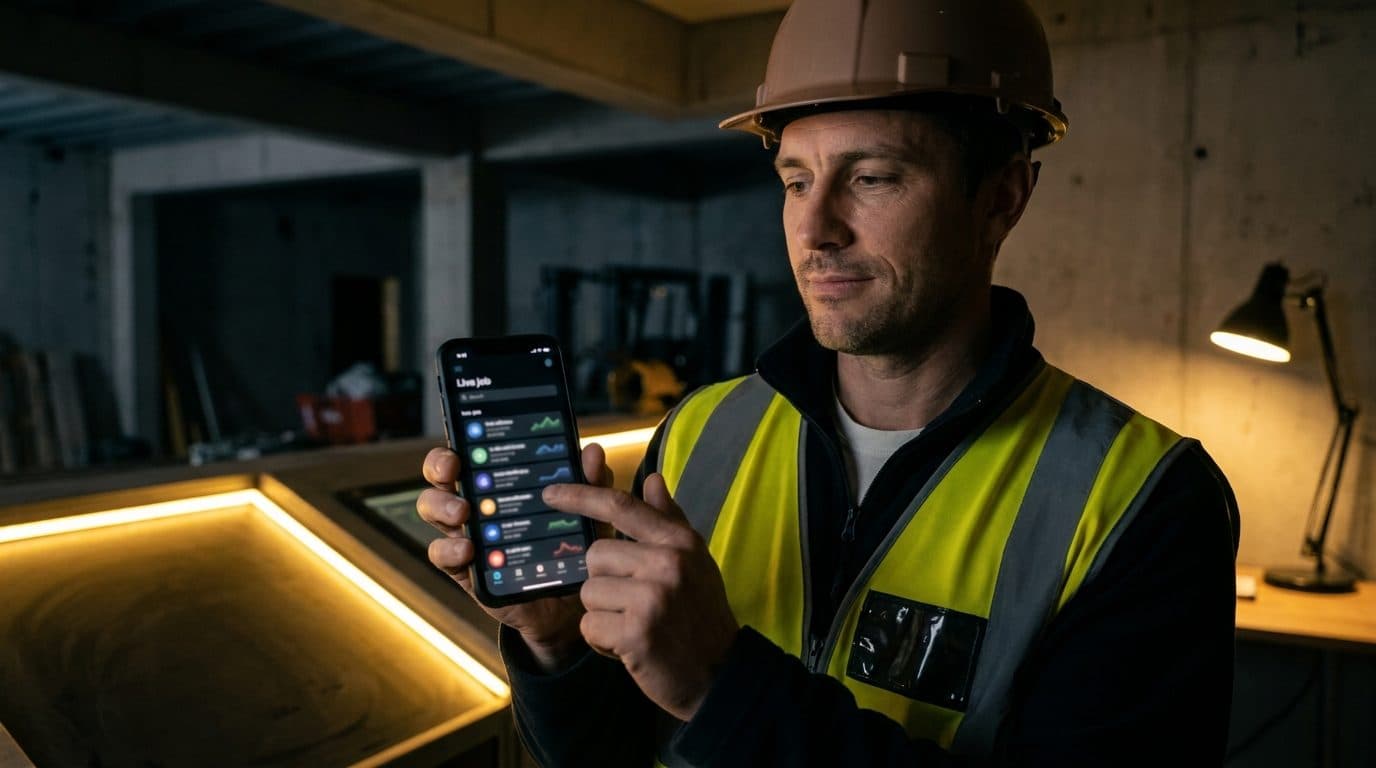
- 04Track every live job: client price, trade costs, running margin. A simple spreadsheet is enough to start. You should be able to read the state of every active job in minutes without calling anyone on site.
- 05Once you are running two or three jobs in parallel without being on any of them, you have crossed the line. Income no longer requires your physical presence. That is the model working.
A quick note on tax classification
Worth flagging because people assume otherwise. In the US, income from running a construction business - even as an operator who never touches the tools - is generally classified as active business income by the IRS, not passive income under the passive activity rules. Running a business you materially participate in is active income. The same principle applies broadly in the UK, Canada, Australia, and New Zealand: operating a business is business income.
This post uses 'passive' in the plain-English sense - income that does not require you to be physically on site. Not in the tax code sense. How your income is actually taxed depends on your business structure, country, and state or province. See the country-by-country model overview for a starting point, and get advice from an accountant who understands construction business structures before making any decisions.
The model is not a tax strategy. It is a business strategy. The income it produces is real, it is earned from real jobs, and it is taxed like real business income. The advantage is not what you pay - it is how much you make while doing less of the physical work yourself. For the full breakdown of how the money works in practice, visit constructionarbitrage.com.
Ready to understand the operator model in full - how the money works, what is legal in your country, and the exact steps to start running jobs without being on them?
Get inside the playbook⟶Frequently asked questions
Can a contractor make passive income?+
True set-and-forget passive income is rare in construction. The closest model is running jobs as a general contractor (main contractor in the UK) - sourcing clients, pricing jobs, and managing subcontractors to deliver them. You earn the margin without touching the tools. It is active in the setup and near-passive once the systems are running.
What is the best passive income stream for a contractor?+
The operator model - running jobs you never personally work on as the general contractor - is the highest-leverage option. Equipment rental and digital products can add income on top, but rarely come close to replacing job margins at construction scale.
How much can a contractor earn running jobs without being on site?+
It depends on job size and how many you run in parallel. Illustrative example in USD: an operator running three jobs simultaneously, each generating $6,000-$15,000 in margin, earns more in a month than most on-tools contractors earn in a quarter. The income scales with the number of concurrent jobs, not the hours on site (figures in USD - the math is the same in any currency).
Is the operator model classified as passive income for tax purposes?+
In most countries, no. In the US, running a construction business - even as a general contractor who never touches the tools - is typically classified as active business income by the IRS, not passive income under the passive activity rules. Tax treatment varies by country and business structure. Always consult a qualified accountant for your specific situation.
Do I need to quit the tools to start?+
No. Start by subcontracting the next job you would have turned down. Quote it to the client, pay your trades from it, keep the margin. Build the operator model in parallel with what you already do, then shift the balance once the numbers make sense.
What other passive income streams can contractors explore?+
Beyond the operator model: equipment rental (tools or plant that sit idle between your own jobs), referral arrangements with suppliers (check legal and tax rules in your country and state), and teaching or consulting once your system is proven. These are supplementary - they compound on top of the operator income, not instead of it.
The human behind The Playbook

mointhemarket Managing construction businesses across continents - with full location freedom. Running several at once. Bought and sold many more.
Go deeper
Learn the model, then get in the room
The full breakdown of construction arbitrage lives on our sister site, constructionarbitrage.com. When you want the operators who actually run it, join the Construction Arbitrage Players community.
My listening book THE EDGE is out now - 24 chapters on how the money really moves through a contracting business, made to be listened to on the drive. Free to start. See what is inside.
My book The Family Secret - how construction arbitrage really works - is coming soon.
Only Players Know
The game is real. The room is closed.
Contractor Club is a private, application-only circle of construction arbitrage operators. If you think you belong inside, apply and the circle will decide.
More from the Playbook
View all ⟶ Work Less & Systems
How to Get Off the Tools in Construction (Without Losing Income)
Your body is the only asset in a tools-first business, and it is depreciating. Here is the four-step path off the tools that does not start with hiring an employee you cannot afford.
 Work Less & Systems
How to Manage Multiple Construction Jobs at Once
Most contractors cap out at the number of jobs they can hold in their head. The operators who scale past that do not work harder - they run every job on one system.