

How to Systemize a Construction Business: The Operator's Method

Most construction business owners are the hardest worker on their own payroll. First call in the morning, last message at night, on site when the trades stall, on the phone when the client panics. That is not a business growing. That is a person running faster to stay in the same place.
The contractors who actually get free - time-free, location-free, money-working-while-they-are-not - are running what I think of as construction arbitrage: the general contractor (main contractor in the UK) model where you manage the margin without delivering the labor. Whether you call it that or not, the discipline that makes it work is the same everywhere. It is systems - documented, transferable, repeatable processes that run the business whether you are watching or not. Here is exactly how to build them.
What 'systemizing' actually means
Most contractors hear 'systemize the business' and picture expensive software or complex org charts. That is not it. A system is a documented process that produces a consistent result regardless of who follows it. It lives in writing, not in someone's head. When a quote gets built the same way every time, when a client gets updated at the same milestones every time, when a trade gets briefed with the same written scope every time - that is a systemized business. Software is just a delivery mechanism for the system. The system comes first.
- A system is any process that produces a consistent result without your direct involvement.
- If only you can do it, it is not a system - it is a dependency.
- The goal is not to automate everything. The goal is to document everything so someone else can do it.
Why most construction businesses never get systemized
The reason is simple and it sounds like a compliment: the owner is always the best person in the room. When a quote needs to go out fast, the owner does it - because they are faster. When a trade needs briefing, the owner calls - because they know the project. When a client is unhappy, the owner handles it - because they know how to smooth it over. Every time the owner does this, they solve the immediate problem and quietly confirm the pattern: the business runs because of one person, not because of a process.
Being the best person in your business feels like success. It is not. It is a ceiling.
@mointhemarket
Breaking out requires one deliberate decision: for every repeating task in the business, you either document how to do it or you stop doing it yourself. Not both. Pick one. The moment you document the quoting process, you stop being the quoting bottleneck. The moment you appoint a site lead with a written scope, you stop being the site bottleneck. That is all systemizing is: moving the business's critical functions out of your head and into a format someone else can follow.
The 5 systems every construction business needs
Five functions must run without you before a construction business can genuinely scale or step back. Build these five and the business starts working for you instead of the other way around.
- Lead generation. A system that brings in enquiries without you personally chasing them. Paid ads on Google or Facebook/Meta running to a landing page that captures inbound leads automatically. No chasing, no word-of-mouth dependency. Leads come to you.
- Quoting and pricing. A documented template that anyone who understands your cost categories can follow. Your margin target, your cost buckets - labor, materials, access, risk - and your method for handling variables. Written down, not stored in your head.
- Site management. Clear written scopes for every job, a trusted site lead or lead subcontractor with authority to make ground-level decisions, and an update rhythm - daily photos, weekly cost check, milestone sign-offs - that replaces your physical presence on the ground.
- Client communication. Templates for milestone updates, a business contact channel off your personal mobile, and a process for handling the most common client queries without you being involved.
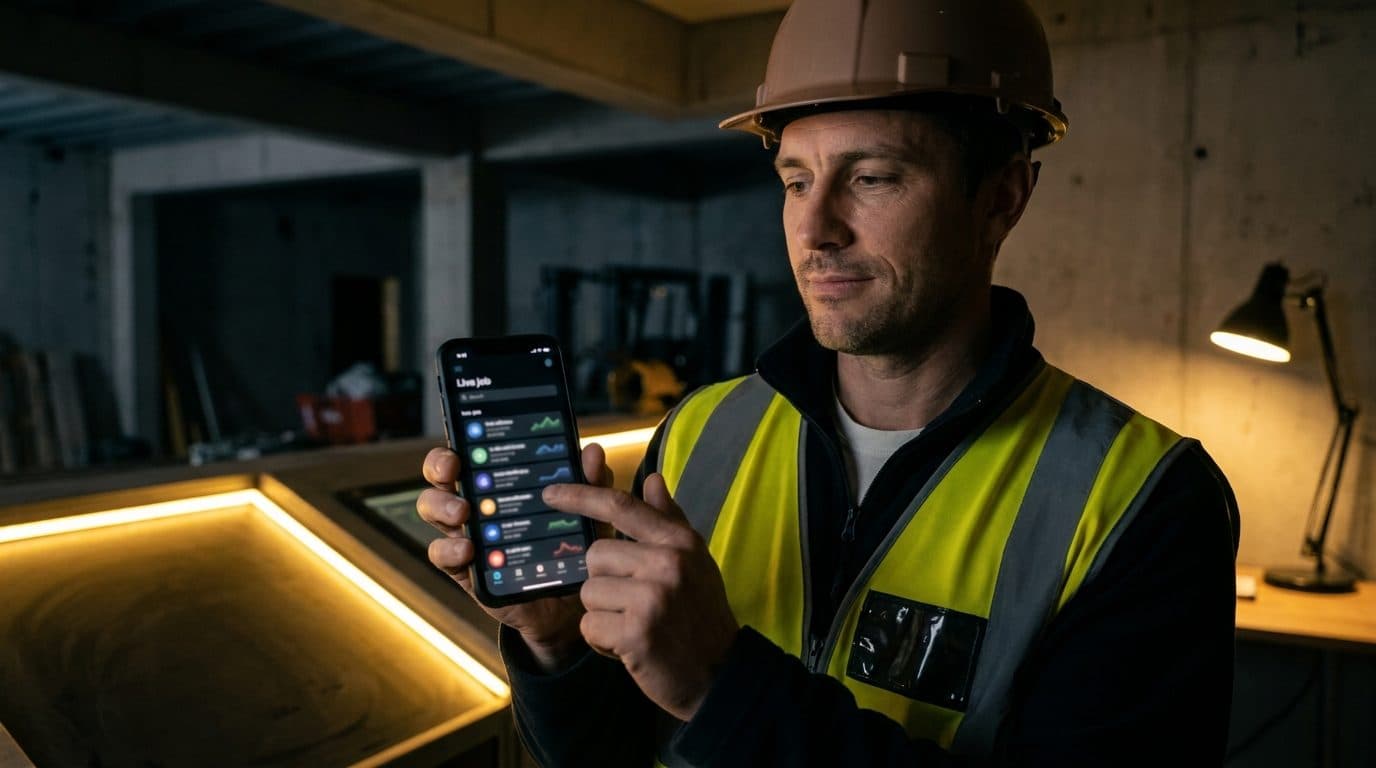
- Financial tracking. A simple per-job tracker showing revenue, costs, and margin in real time. You should be able to read the state of every live job in under two minutes from anywhere, without calling anyone.
How to document a system that actually works
Here is the method for turning any repeating task into a documented process you can genuinely hand to someone else.
- 01Do the task once while you write down every step. Not a summary - every step. What do you check first? What tool do you open? What do you say? If you skip steps because they feel obvious, someone following the document will get stuck at exactly those steps.
- 02Give the written version to someone else and have them follow it without asking you questions. Watch where they hesitate or get stuck. That is what is missing from the document.
- 03Add the missing steps and repeat until someone can follow it to completion without a single question. A system is only finished when it runs without you explaining it.
- 04Name the system and put it somewhere the team actually accesses. A shared folder, a project management tool, a printed binder - whatever your team uses. A process in a file nobody opens is not a system.
- 05Review and update it every quarter. Your process evolves as the business grows. A system that reflects how you worked eighteen months ago is worse than no system at all.
The tools that support a systemized construction business
Tools do not create systems - but the right tools make systems easier to maintain. Here is what most operators actually use, without overcomplicating it:
- A shared document folder (Google Drive, Dropbox, or similar) for scopes, quote templates, checklists, and client-facing documents. One place, everyone can access it.
- A simple spreadsheet or basic job management app for per-job cost and margin tracking. You do not need enterprise software to know whether each job is making money.
- A separate business number or CRM for client communication. Keep it off your personal phone from day one on every new project.
- WhatsApp groups per site for photo updates and trade coordination. Primitive? Yes. Effective? Absolutely. The site lead knows where to post updates; you check in on your own schedule.
- Paid ads running to a landing page for lead generation. This is the one most operators underinvest in - and then wonder why they are still chasing referrals and waiting for the phone to ring.
How construction arbitrage forces you to systemize
Everything above is what you retrofit into a traditional construction business to make it run without you. Construction arbitrage is the model that starts there by design. The general contractor is never the worker on site. The whole structure - sourcing the client, pricing the job, briefing the trades, keeping the margin - is built to operate from a laptop without your boots on the ground. If you are never on site, every function that would normally depend on your physical presence must be a documented process instead. The model does not leave you the option of being the dependency. Build the systems or it breaks.
(Figures in USD - the model and the math are identical in any currency.) A bathroom gut-renovation and refit sells to the client for $22,000. Trades and materials - plumber, tiler, and supplies - cost $14,000. You keep $8,000. Stack four of those in parallel and you are banking $32,000 a month from a laptop without setting foot on any of the sites. That only works if all five systems above are in place. No system, no arbitrage. It is that direct.
The 90-day path to a more systemized business
| Phase | What to build |
|---|---|
| Days 1-30 | Document your quoting and pricing process. Appoint a site lead on current jobs. Set up a business contact channel for all new clients. |
| Days 31-60 | Launch or refine paid ads for lead generation. Build a per-job cost tracker for every live job. Write the scope template you will use for every new project from here forward. |
| Days 61-90 | Run one full job without a single personal site visit. Use photo updates, the site lead, and the milestone rhythm. Note what breaks and fix it. That job is your proof of concept. |
Three months. One job that runs without you. Once you have done it once, you know the system works and the next ten follow the same template. For a deeper look at the operator model that runs entirely on this infrastructure, explore constructionarbitrage.com.
The operators who build this way - systems, margin, remote - are the ones Contractor Club is for. If you think you belong in the room, request entry.
Request entry to Contractor Club⟶The bottom line
Systemizing a construction business is not about buying software. It is about getting every repeating function out of your head and into a documented process someone else can follow: lead generation, quoting, site management, client communication, financial tracking. Build those five systems and the business starts running without you. And if you want a model that was designed from the ground up to run without the owner's presence, study how construction arbitrage works - the structure where never being on site is not a future goal. It is how it starts. Build the systems. Keep the margin. Only players know.
Frequently asked questions
How do I systemize a construction business?+
Start by documenting the five core repeating functions: lead generation, quoting and pricing, site management, client communication, and financial tracking. For each one, write down the process so someone else can follow it without asking you questions. A system is not software - it is a documented process that produces a consistent result without your direct involvement every time.
Why do most construction businesses stay unsystemized?+
Because the owner is usually the fastest, most competent person in the room. Every time the owner handles a quote, briefs a trade, or deals with a client personally, they solve the immediate problem and quietly confirm that the business depends on them. Breaking out requires a deliberate decision to document every repeating task instead of just doing it yourself again.
What systems does a construction business need to run without the owner?+
Five core systems: a lead generation system that produces inbound enquiries automatically, a documented quoting and pricing template anyone can follow, a site management system with a trusted site lead and written scopes, a client communication system that runs off the owner's personal phone, and a per-job financial tracker that shows margin in real time.
Can you systemize a construction business without expensive software?+
Yes. Most operators run effectively with a shared document folder for templates and scopes, a spreadsheet for job cost tracking, a separate business number for client communication, and a WhatsApp group per site for photo updates. Software helps, but the system is the process - not the tool. Build the process first, then add software if it makes it easier.
How does construction arbitrage relate to systemizing a construction business?+
Construction arbitrage - the model where you operate as the general contractor without being on site - forces systemization because there is no physical presence to fall back on. Every function that would normally depend on the owner being present must be built into a documented process instead. The arbitrage model does not leave you the option of being the dependency.
How long does it take to systemize a construction business?+
A meaningful foundation can be built in 90 days. Days 1-30: document your pricing process, appoint a site lead, set up a business contact channel for new clients. Days 31-60: launch or refine paid ads, build a per-job cost tracker, write your scope template. Days 61-90: run one complete job without a single personal site visit. That proof of concept changes how you build every job after it.
The human behind The Playbook
mointhemarket Managing construction businesses across continents - with full location freedom. Running several at once. Bought and sold many more.
Go deeper
Learn the model, then get in the room
The full breakdown of construction arbitrage lives on our sister site, constructionarbitrage.com. When you want the operators who actually run it, join the Construction Arbitrage Players community.
My listening book THE EDGE is out now - 24 chapters on how the money really moves through a contracting business, made to be listened to on the drive. Free to start. See what is inside.
My book The Family Secret - how construction arbitrage really works - is coming soon.
Only Players Know
The game is real. The room is closed.
Contractor Club is a private, application-only circle of construction arbitrage operators. If you think you belong inside, apply and the circle will decide.
More from the Playbook
View all ⟶ Work Less & Systems
How to Get Off the Tools in Construction (Without Losing Income)
Your body is the only asset in a tools-first business, and it is depreciating. Here is the four-step path off the tools that does not start with hiring an employee you cannot afford.
 Work Less & Systems
How to Manage Multiple Construction Jobs at Once
Most contractors cap out at the number of jobs they can hold in their head. The operators who scale past that do not work harder - they run every job on one system.