
What to Post on Instagram as a Contractor (Content That Gets You Jobs)

Most contractors are posting their own faces on job sites, generic motivational quotes, and the occasional blurry finished project photo. Then they wonder why Instagram is not bringing in work. The problem is not the platform. It is the content.
Instagram passed 3 billion monthly active users - one of the largest audiences ever assembled on any platform. Some of those people are right now looking at a cracked kitchen, a leaking roof, or a dated bathroom they want fixed. Whether they find you or find someone else is mostly a content decision. And this is really a conversation about construction arbitrage - the model where you position yourself as the operator who gets the client, not just the tradesperson who does the work. Instagram is where you find the client before they know to look for you.
The content type that converts above everything else
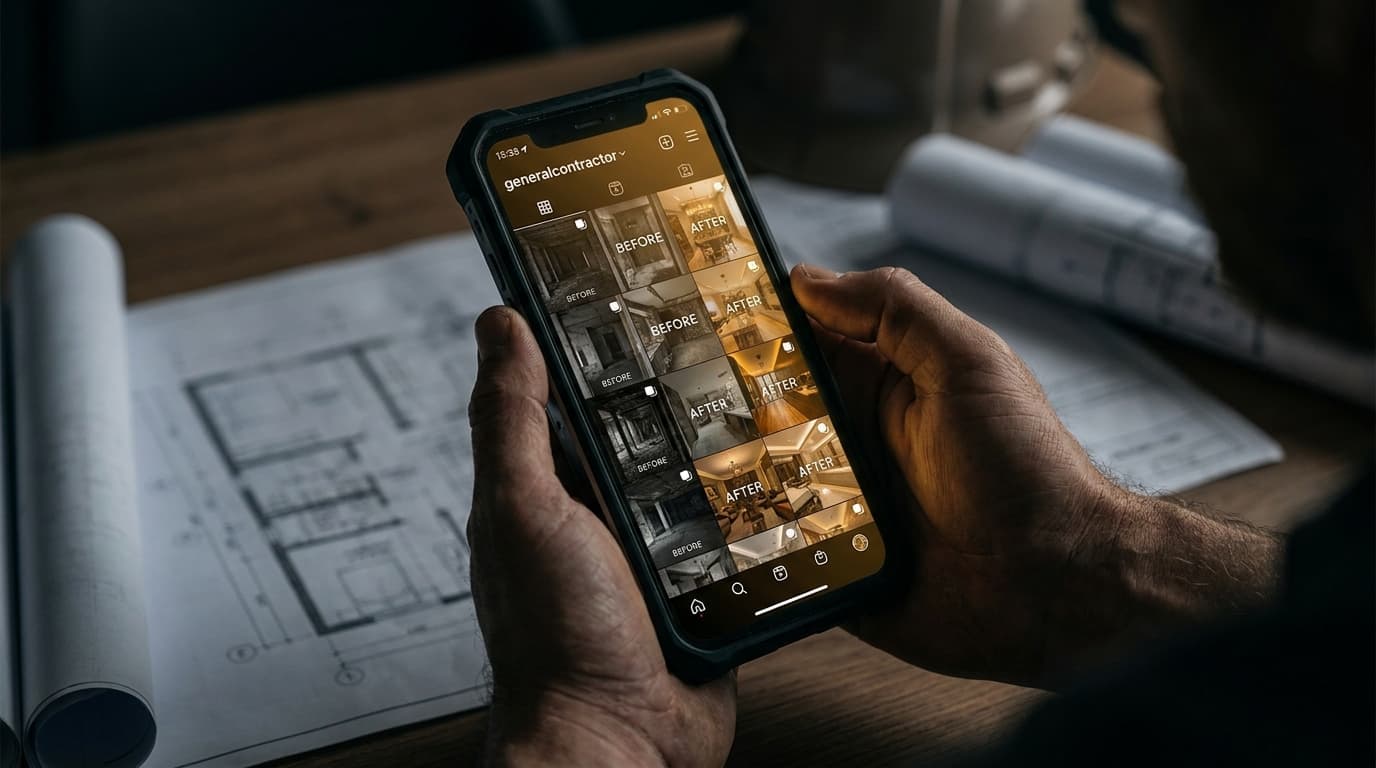
Before and afters. Full stop. A side-by-side or swipe-through carousel of the kitchen before you touched it versus how it looks now does more selling than any ad copy. It answers the only question a potential client actually has: can this person do the work to a standard I want in my home?
The rules for a before/after that actually does something: shoot both at the same angle, same light conditions if possible, and make sure the after is cleaned, styled, and photographed properly. A fuzzy after shot undercuts the whole job. If the work is good, let it look good.
Reels: how you get found by people who do not follow you yet
Instagram pushes Reels harder than any other format to audiences who do not already follow you. Static posts stay inside your existing follower base. A well-made Reel can reach people across your city, your state, your country - people who are exactly your client but have never seen your account. That reach gap is significant and has been the consistent direction of the platform's algorithm for several years.
What makes a Reel worth watching as a general contractor (main contractor in the UK)?
- Time-lapse or fast-cut project progress. Framing going up, tiles being laid, a floor being sanded and sealed. Satisfying to watch, hard to scroll past. 15-30 seconds is the sweet spot.
- Before and after reveal with a transition. One cut or wipe transition from demolition chaos to finished room. You can do this on any free editing app.
- A tip or quick answer. '3 things to check before hiring a general contractor' takes 30 seconds to say. People save and share these. They position you as someone who knows the trade.
- Problem and fix. Show a common issue you came across on a job and how you resolved it. Clients watch these to learn; they also watch to confirm you know what you are doing.
- You on camera, talking. Once a week, look at the phone and say one useful thing. It is the fastest trust builder on the platform.
Carousels: the format that holds attention and gets saved
After Reels, carousels are the format with the best performance for contractors. A carousel (swipe-through post) holds people on your content longer than a single image, which the algorithm rewards with more distribution. It is also the format most likely to be saved - and saves signal to Instagram that your content is worth showing to more people.
Use carousels for: before/after sequences, a 'step by step' breakdown of a project, multiple shots of a large job showing different areas, and client testimonial screenshots with a closing image of the finished work.
Testimonials: borrow other people's credibility
A screenshot of a genuine client review or a direct quote from a happy client, paired with a photo of their finished project, does something your own captions cannot: it proves you deliver. No contractor is going to write 'I am reliable and I do quality work' and have anyone believe it. A client writing exactly that is a different story.
The format that works best: client quote as text overlay on the finished project photo, with a caption that gives context on what the job was. If they are willing to go on camera for a 15-second Reel, that is better still.
What not to post
Some content kills accounts silently. It does not go viral in a bad way - it just does nothing, over and over, until the account looks dead:
| Avoid this | Do this instead |
|---|---|
| Stock photo of tools or a house | Your own work, any quality of phone |
| 'Happy Monday!' with no context | A real tip or project update |
| Blurry site photos with no caption | One clean photo + what the job was |
| Sales post every day ('call us now!') | Value first, CTA second |
| Quoting prices in the caption | DM or link for quotes - keep the conversation off comments |
| Sharing other people's content constantly | Original posts, even short ones |
The posting rhythm that builds without burning out
You do not need to post every day. You need to post consistently. Consistency is what the algorithm rewards and what keeps you present in a follower's mind when they finally need a contractor. The approach that works for operators running jobs in parallel:
- 01Monday or Tuesday: One Reel from the previous week's jobs. Shoot a quick time-lapse or process clip on site, edit on your phone, post with a local hashtag.
- 02Wednesday or Thursday: One before/after carousel or static post from a completed job.
- 03Friday or weekend: One testimonial post or an educational tip - something people save or share.
- 04Stories daily or every other day: Behind the scenes, polls, Q&As. Stories keep your account active between grid posts and keep followers warm.
That is three to four posts per week plus daily stories. It can be done in under an hour a week if you batch shoot on site and edit in downtime. This is the kind of system that scales - the same logic as construction arbitrage applied to your content: build the system once, then run it with minimal friction.
Captions and hashtags: the part most contractors skip
A great photo with no caption is a missed opportunity. The caption is where the context goes - what the job was, where you work, and what you want them to do next. Keep it short. Three to four lines max. One sentence that describes the job, one that names your area, and one that tells them what to do ('DM for a quote', 'link in bio to book a survey').
On hashtags: use 5-10 focused, relevant ones. Mix your location (#DenverContractor, #AucklandBuilder, #LondonConstruction) with your trade (#KitchenRemodel, #GeneralContractor, #Renovation) and leave it there. The days of 30-hashtag walls are over - the algorithm reads content, not tag count.
The real reason Instagram matters for the construction arbitrage operator
Here is the thing most people miss. Instagram is not just a lead channel. It is a trust machine. By the time someone contacts you via Instagram, they have already decided you probably know what you are doing. They have watched your Reels, scrolled your before/afters, read your captions, maybe watched a testimonial. The sales call is already halfway done before it starts.
That is the edge the construction arbitrage model runs on. You are not just another contractor asking for work. You are the operator with a documented track record on a public profile. Clients come pre-sold. Follow @mointhemarket on Instagram to see what that looks like in practice.
If you are ready to build the system - the clients, the subs, the margin, and the profile that makes it all work - Contractor Club is where that conversation happens.
Request entry to Contractor Club⟶Frequently asked questions
What should a contractor post on Instagram to get clients?+
Before and after photos are the highest-performing content type for contractors on Instagram. Pair them with short Reels showing the transformation process and you cover both discovery (Reels push you to new audiences) and trust (before/afters prove quality to people deciding whether to call).
How often should a contractor post on Instagram?+
Three to four times per week is a sustainable and effective rhythm. Mix formats: one or two Reels for reach, one carousel or before/after for trust, one story or educational post for engagement. Consistency beats volume - two quality posts a week beats seven mediocre ones.
Do Instagram Reels work for contractors?+
Yes. Reels are the fastest way to reach people who have never heard of you. A 15-30 second time-lapse of a tiling job, a bathroom reno, or a framing sequence gets pushed to local audiences who are not yet following you. It is the best discovery tool on the platform.
What hashtags should contractors use on Instagram?+
Mix local hashtags (your city or region, e.g. #ChicagoContractor, #DallasBuild) with trade hashtags (#GeneralContractor, #Remodeling, #HomeRenovation) and a couple of niche hashtags specific to the job (#KitchenRemodel, #EpoxyFloors). Keep it to 5-10 focused tags rather than 30 irrelevant ones.
Should I show my face on Instagram as a contractor?+
Yes, and it is one of the highest-leverage things you can do. People hire people, not faceless companies. A short talking-head Reel where you explain something useful about your trade builds trust faster than any polished before/after. You do not need a ring light - just good natural light and a clear point.
Can Instagram bring in real leads for a construction business?+
Absolutely - but it works best as a trust layer, not a cold-calling tool. Someone sees your Reel, follows you, scrolls your grid of quality work, then DMs or calls when they need a contractor. The platform builds the case for why you are the right person to hire before a word is exchanged.
The human behind The Playbook
mointhemarket Managing construction businesses across continents - with full location freedom. Running several at once. Bought and sold many more.
Go deeper
Learn the model, then get in the room
The full breakdown of construction arbitrage lives on our sister site, constructionarbitrage.com. When you want the operators who actually run it, join the Construction Arbitrage Players community.
My listening book THE EDGE is out now - 24 chapters on how the money really moves through a contracting business, made to be listened to on the drive. Free to start. See what is inside.
My book The Family Secret - how construction arbitrage really works - is coming soon.
Only Players Know
The game is real. The room is closed.
Contractor Club is a private, application-only circle of construction arbitrage operators. If you think you belong inside, apply and the circle will decide.
More from the Playbook
View all ⟶ Social Media
How Content Marketing Brings in Construction Leads (And Why It Beats Ads Long-Term)
Paid ads stop the minute you stop paying. Content marketing is the opposite - it compounds over time and keeps bringing in leads while you are on a job. Here is the system behind it.
 Social Media
Should Contractors Start a YouTube Channel? The Honest Answer
YouTube can compound into your best lead source - or it can eat 12 months of evenings for nothing. Here is the honest answer on whether a YouTube channel is worth it for a contractor.