

Most contractors who want their business to run without them go looking for a system to add on top of what they already have. A better CRM. A checklist for their site lead. An app to track jobs. They are solving the wrong problem. The issue is not the systems. The issue is the model. A business built around your hands will never run without your hands, no matter how many tools you layer on top of it.
Here is what I have learned from running this myself - what I am really pointing at is the architecture underneath the construction arbitrage model. Not the CRM. Not the checklist. The fundamental design decision of what you sell and who does the work. Get that right and the rest of the systems slot in naturally. Get it wrong and you are adding overhead to a job you own, not a business.
Why most construction businesses never run themselves
The structural reason is straightforward. Most contractors build a business around their own labor. They are the best person on the tools, so they do the work. They are the most reliable person on site, so they stay on site. They are the only one who knows how to price a job, so every quote runs through them. Over time, they build a business that is literally structured around their presence - and then wonder why they cannot leave it.
You cannot systemize your way out of that. No playbook replaces a person who is load-bearing in every function. The fix is not operational. It is architectural. Start there.
The design decision that changes everything
A construction business that runs itself is not built on better systems. It is built on the right model. Specifically: the general contractor (main contractor in the UK) coordination model, where you price the job, source the trades, and manage the outcome - without ever picking up a tool yourself.
This is the model known as construction arbitrage when it is run deliberately. Source the client, price it right, put trusted subs on the work, keep the spread. Your value is not in your hands - it is in your ability to price well and source well. The moment you make that shift, building a business that does not need you is not a puzzle to solve. It is just how the model works.
The four pillars of a self-running construction business
Once the model is right, four things need to be built - and they need to be built in this order:
- A sub bench, not a sub list. A list is names and phone numbers. A bench is tested relationships - trades you have worked with, paid on time, and trust to run a site without babysitting. One reliable sub per trade is the engine of the whole operation. You cannot coordinate what does not exist.
- A documented pricing system. If your pricing process lives in your head, you are the bottleneck on every quote. Write down how you cost a job: your categories, your margin targets, how you handle risk and variables. Once it is documented, it can be delegated. Until then, every quote is a reason to need you.
- An inbound lead system. Word of mouth keeps you busy. An inbound system grows without you. Whether that is a Google ad, a lead page, or a referral partner arrangement, the goal is work arriving without your effort. The moment leads come in on their own, the front end of the business runs without you.
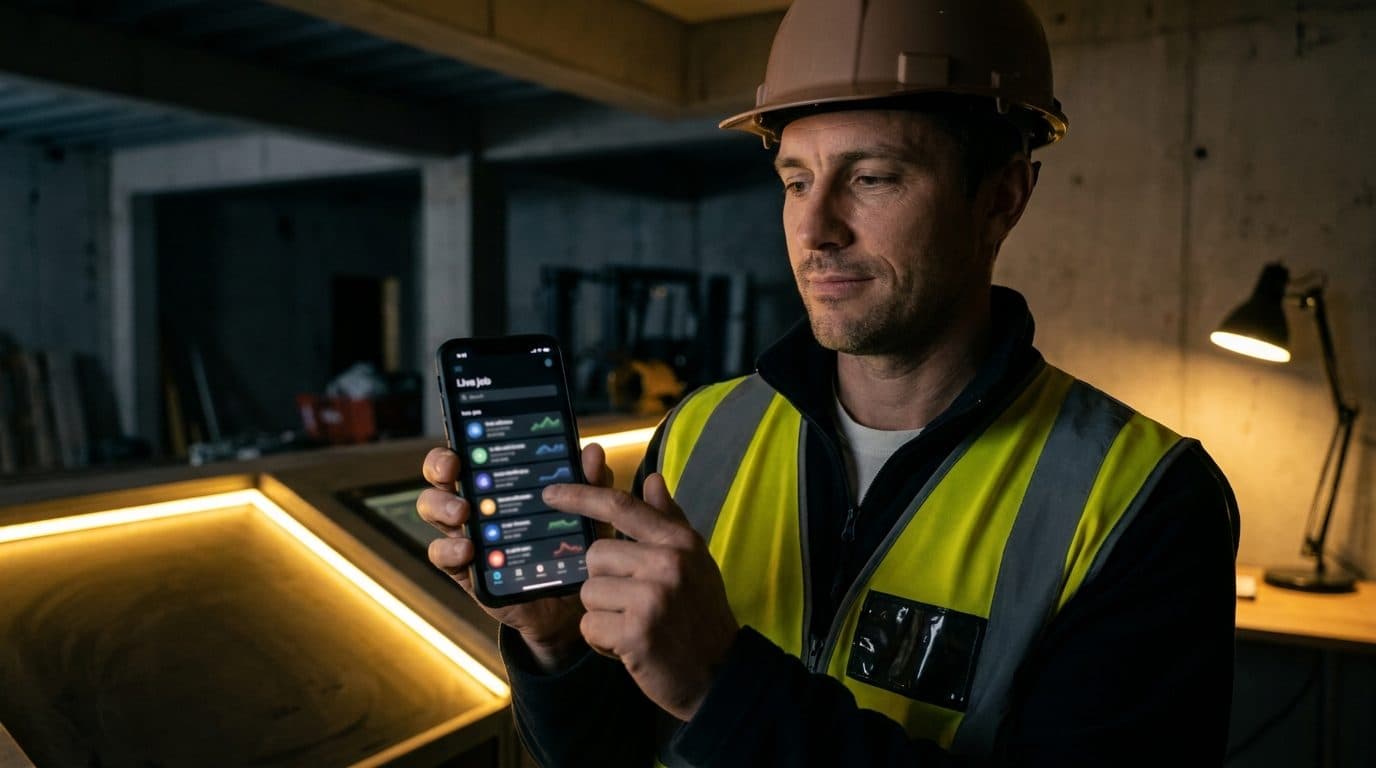
- A job tracker you can read in five minutes. Revenue, costs, and margin per job, visible at a glance from anywhere. You do not need a sophisticated platform - a clean spreadsheet updated by the site lead on a weekly rhythm works fine. What you need is the ability to know the state of every job without calling anyone.
That is the minimum viable self-running machine. Four things. Not forty.
Building a sub bench that does not fail when one person is unavailable
The part most operators get wrong is treating their sub network as a convenience rather than infrastructure. They have one electrician they like and one plumber they trust, and no backup. The moment either is unavailable, the job stalls - and the owner has to step in. That is a single point of failure, not a system.
(Figures in USD - the model and the math are identical in any currency.) The benchmark to aim for: at least two qualified subs per trade, tested on a real job, paid on time, and given steady volume. Trades who earn $8,000 to $12,000 a month consistently from a single operator treat that operator's jobs differently from a one-off. Build that loyalty through reliable payment and regular work. The sub bench is not a backup plan. It is the engine.
Your sub bench is not a convenience. It is the entire machine. Build it like it is, because it is.
@mointhemarket
The pricing system that removes you from the revenue bottleneck
Writing down how you price a job is the single highest-leverage thing most operators have never done. Not a formula - a full process document. How you run a site visit. What you measure. How you calculate materials and labor costs. What markup you apply at each stage. How you handle uncertainty and complexity. When that document exists, someone else can follow it. When it lives in your head, you are personally required for every job that gets sold.
There is a second benefit. When you write the pricing process down, you see where it leaks. Operators who price instinctively often undercharge on complexity and overcharge on simple work. Putting it in writing surfaces those inconsistencies - and then fixes them. Your margins get better the moment you stop keeping them secret from yourself.
The decision filter that replaces constant owner involvement
Every self-running business has one underlying mechanism: a decision filter. A documented set of rules that determines who decides what, without reference to the owner. Write it once. Enforce it always. In a construction operation, it looks something like this:
| Decision type | Who decides | Escalate to owner when |
|---|---|---|
| Daily site sequencing and timing | Site lead or sub | Never - they own the site |
| Minor materials substitution (same spec) | Site lead | Cost impact is significant |
| Client update on progress | Site lead via update template | Client is dissatisfied |
| Scope change or additional work | Owner | Always - this is a money decision |
| Sub performance or quality issue | Owner | Always - this affects the outcome |
Anything that is not a money decision or a relationship decision can - and should - be handled without you. Write those categories down. Give the site lead real authority inside that boundary. Watch how fast the volume of messages you receive drops.
The two-week test: how to know if you have actually built it
This is not a lifestyle goal. It is a diagnostic tool. The operators who can pass this test are running an asset. The ones who cannot are running a job with a company name on it. Both can be profitable. Only one can be scaled, sold, or stepped back from with confidence. The construction arbitrage model is specifically built to pass this test - because the owner was never the worker to begin with.
How to move from where you are to where you want to be
- 01Commit to the coordination model on your next job. Price it yourself, source the labor, manage the outcome - do not touch a tool. Even if the margin is modest to start, you are learning how the system feels from the right side of it.
- 02Write your pricing process this week. Even a rough first version. It does not need to be perfect - it needs to exist. You can refine it in month two. Right now it lives in your head, and that makes you the ceiling of your own business.
- 03Identify one backup sub per trade where you currently have no redundancy. Call them. Introduce yourself. Give them a small job. Build the relationship before you need it urgently.
- 04Set a weekly operating rhythm with your site leads. End-of-day update, mid-week cost check, pre-handover walkthrough. Give them real authority inside the scope. Pull them back only for scope changes and money decisions.
- 05Build one inbound channel. A simple landing page with a modest ad budget is enough to prove the concept. The goal is one new enquiry a month that arrived without you making a call. Once you have that, you scale it.
Operators who commit to the coordination model and build the four pillars properly have a functioning self-running machine inside six months. Not perfect - functioning. The perfection comes later. The structure is urgent.
A business that runs itself does not need you standing on it either - see can you run a construction business remotely for what that looks like once the four pillars are in place.
The full model - what construction arbitrage is, how the numbers work, and how to run it from scratch - lives on our sister site. Start there.
Learn construction arbitrage⟶The bottom line
A construction business that runs itself is not a lucky accident and it is not the reward you get after twenty years of grinding. It is a design outcome. You choose the model first - coordination over labor. You build the four pillars in order. You write the decision filter down and enforce it. Then the business runs - not because you hired the right manager, but because you built the right architecture. That is the whole game, and the operators who know it are not telling anyone. Now you know. The next step is at Contractor Club.
Frequently asked questions
Can a construction business really run without the owner?+
Yes - and most large general contractors already operate this way. The general contractor coordinates subcontractors, manages the project outcome, and keeps the margin. They are never the person swinging the hammer. Smaller operators running the same model - often called construction arbitrage - run it from a laptop with no tools in hand.
What is the difference between a self-running construction business and one that depends on the owner?+
An owner-dependent business stops earning when the owner stops showing up. A self-running business has documented systems for getting leads, pricing jobs, managing site progress, and handling client communication - so each function works whether or not the owner is reachable. The model matters first: a coordination model is inherently more self-running than a labor model.
Do I need to hire staff to build a construction business that runs itself?+
Not necessarily. The core engine is a reliable bench of subcontractors, not employees. Trusted subs execute the work on site. Your job becomes pricing, sourcing clients, and managing the outcome - which can be done without building a payroll. Systems replace headcount more effectively than hiring does.
How do I start building a self-running construction business from scratch?+
Start with the model: commit to coordinating the job rather than doing it yourself. Source two or three trusted subs per trade. Document your pricing process so it is reproducible. Build a simple inbound lead system so work finds you. Set up a job tracker you can check in five minutes from anywhere. That is the minimum viable self-running machine.
How does construction arbitrage fit into building a self-running business?+
Construction arbitrage is the model itself - the operator sources the job, prices it at general contractor rates, places trusted subs on the work, and keeps the spread. Because the owner never does the physical work, the model is designed to be self-running from day one. It is not a feature you add later; it is the structure.
What are the biggest mistakes contractors make when trying to build a self-running business?+
Three common ones: trying to systemize a model that is fundamentally owner-dependent (layering systems onto a labor business never works), building systems before a reliable sub bench exists (no reliable people, no system), and keeping all pricing in their head instead of documented (the single biggest bottleneck in most operations).
The human behind The Playbook

mointhemarket Managing construction businesses across continents - with full location freedom. Running several at once. Bought and sold many more.
Go deeper
Learn the model, then get in the room
The full breakdown of construction arbitrage lives on our sister site, constructionarbitrage.com. When you want the operators who actually run it, join the Construction Arbitrage Players community.
My listening book THE EDGE is out now - 24 chapters on how the money really moves through a contracting business, made to be listened to on the drive. Free to start. See what is inside.
My book The Family Secret - how construction arbitrage really works - is coming soon.
Only Players Know
The game is real. The room is closed.
Contractor Club is a private, application-only circle of construction arbitrage operators. If you think you belong inside, apply and the circle will decide.
More from the Playbook
View all ⟶ Work Less & Systems
How to Get Off the Tools in Construction (Without Losing Income)
Your body is the only asset in a tools-first business, and it is depreciating. Here is the four-step path off the tools that does not start with hiring an employee you cannot afford.
 Work Less & Systems
How to Manage Multiple Construction Jobs at Once
Most contractors cap out at the number of jobs they can hold in their head. The operators who scale past that do not work harder - they run every job on one system.